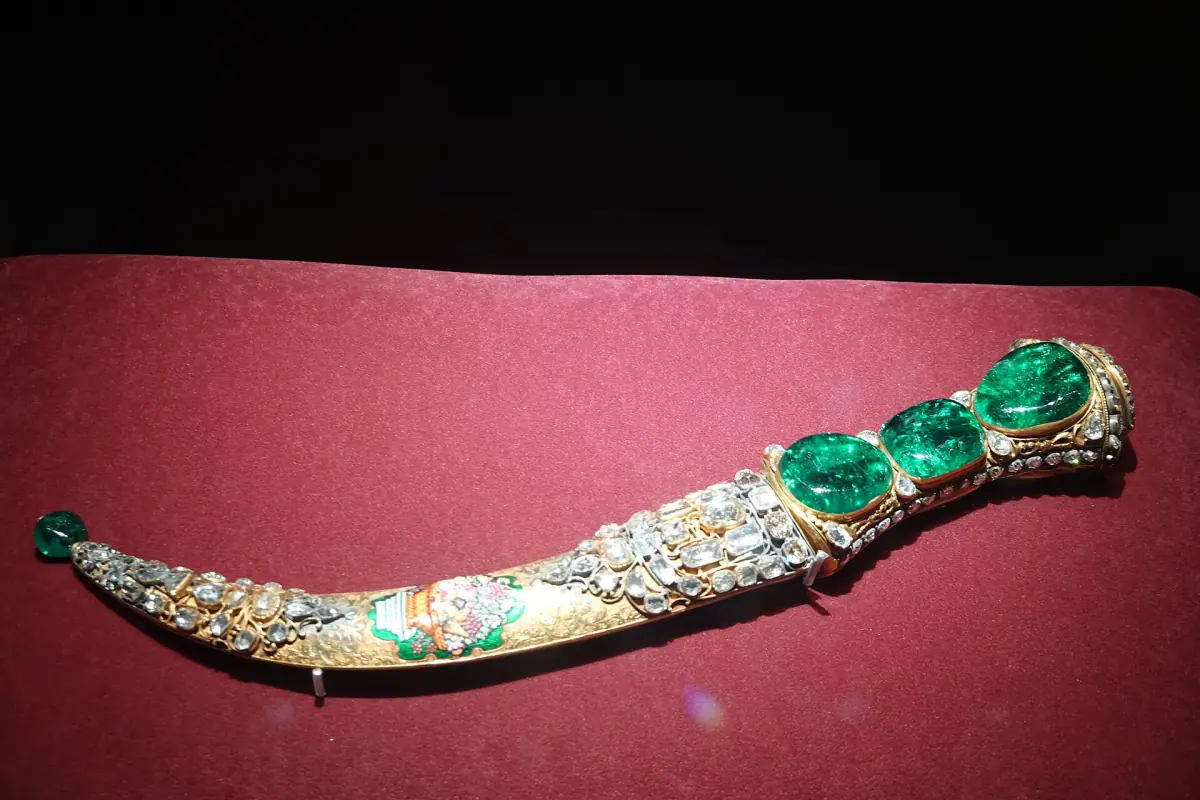
The Topkapi dagger and the imperial treasury
The Topkapi dagger belongs in a wider visit to the imperial treasury and palace collections. Known in Turkish as the Topkapı Hançeri, it is described alongside the Spoonmaker’s Diamond as an outstanding treasury object in the historical art literature. Use those names to prepare your interests, then follow the exhibition information during your visit for the objects on display. A photograph or an older description should guide your curiosity rather than determine a fixed room-by-room itinerary.
The setting matters as much as the celebrated objects. Topkapı served as a residence, a centre of government and a place of education, with its buildings and collections forming part of that wider court world. The palace inventory includes jewellery, weapons, clothing, ceramics and sacred relics. Look for connections between ceremonial display, everyday service and the use of particular spaces. The interior guide explains the courtyards, while the architecture page puts the treasury within the organisation of the palace.

The Spoonmaker’s Diamond in historical context
The Kaşıkçı Elması, or Spoonmaker’s Diamond, is another recognised name in the treasury’s history. A press report dated 12 May 2022, quoting the palace leadership at the time, described it as weighing 86 carats. That is a dated historical description. For your visit, use the current exhibition labels to understand the presentation rather than relying on the room location described in that older report.
Treat stories about the diamond’s origins as stories unless the exhibition clearly identifies their status. You can appreciate the object’s place in the collection without attaching a market value or a neat ownership story to it. This is also a useful approach to the dagger: concentrate on what the labels explain about the object, its materials and its historical context. Decide which collection interests you most before entering, so that a famous name becomes an introduction to the palace rather than your only reason for exploring it.
Our take
This palace and Harem ticket includes an English highlights tour and smartphone audio for your visit.
Hand-picked tours, booked through Viator. Prices are indicative starting prices in euros (as of October 2026). Tap a tour for live availability and the current price in your currency.

Palace and Harem highlights visit
A one-hour English highlights tour, palace and Harem admission, and smartphone audio provide a starting point for exploring the wider palace collections.
A palace introduction with Harem admission
The visit option presented here combines palace and Harem admission with a one-hour highlights tour in English and a digital audio guide on your own smartphone. It provides a general introduction to the palace, with time for further exploration within the opening rules. Choose it if you want guided orientation before continuing with your own collection interests. The guided portion is a palace highlights visit; use the remaining visit to prioritise exhibitions according to the route and access on the day.
Keep admission choices and collection interests together when planning. The ticket page explains the palace ticket arrangements, and the opening hours and visitor rules page covers the Tuesday closure, ticket office and indoor restrictions. If you also want to explore the Harem, consider how its domestic and service spaces complement the ceremonial objects. Avoid turning the hour of guided highlights into a fixed allowance for every treasury room or the full palace visit.
Sacred relics and religious tradition
The sacred relics rooms belong to the Enderun courtyard. The collection includes objects venerated in religious tradition, including the Hırka-i Saadet, revered as the Prophet’s mantle, together with letters, swords and keys of the Kaaba. Describe and approach these associations as religious tradition. They carry a different meaning from the courtly display of jewels, even when you encounter both themes during the same palace visit.
Appropriate covering is required in this area, and the ban on interior photography and video applies during your visit. Prepare for those rules before entering so that you can concentrate on the collection. The palace administration’s account connects the transfer of relics with Selim’s Egyptian campaign of 1517. Read this history alongside the names and explanations attached to the exhibits, keeping the religious attribution distinct from a claim of independently established provenance.
Porcelain, weapons and imperial clothing
The palace collections extend to Chinese, Japanese and European porcelain, glass, copper and tombak, silver, imperial clothing, portraits and weapons. These categories offer different ways into court history. You might focus on the relationship between serving vessels and palace kitchens, or compare objects associated with ceremonial appearance and personal dress. Choose a theme that interests you and let the exhibition labels supply the detail, rather than expecting every category to appear together on a single route.
The Şerbethane presentation adds serving culture to that picture. Its opening was announced on 18 July 2026 with 452 objects concerning sherbet, sweets, pastes, essences and the culture of serving them. Approach it as an exhibition about food and drink in palace life. It is an opportunity to connect vessels and utensils with their cultural setting, while keeping your plans centred on looking and learning.
Frequently asked questions
What is the Topkapi dagger called in Turkish?
It is known as the Topkapı Hançeri and is associated with the imperial treasury.
How large is the Spoonmaker’s Diamond?
A press report of 12 May 2022 quoting the palace leadership described it as 86 carats. This is a historical description.
Does the tour cover every collection?
The included guided portion is a one-hour English palace highlights tour. Prioritise individual collections during your further exploration, following the opening rules.
Is Şerbethane a tasting experience?
Plan it as an exhibition about sherbet, sweets, essences and serving culture. The opening announcement of 18 July 2026 described 452 objects.