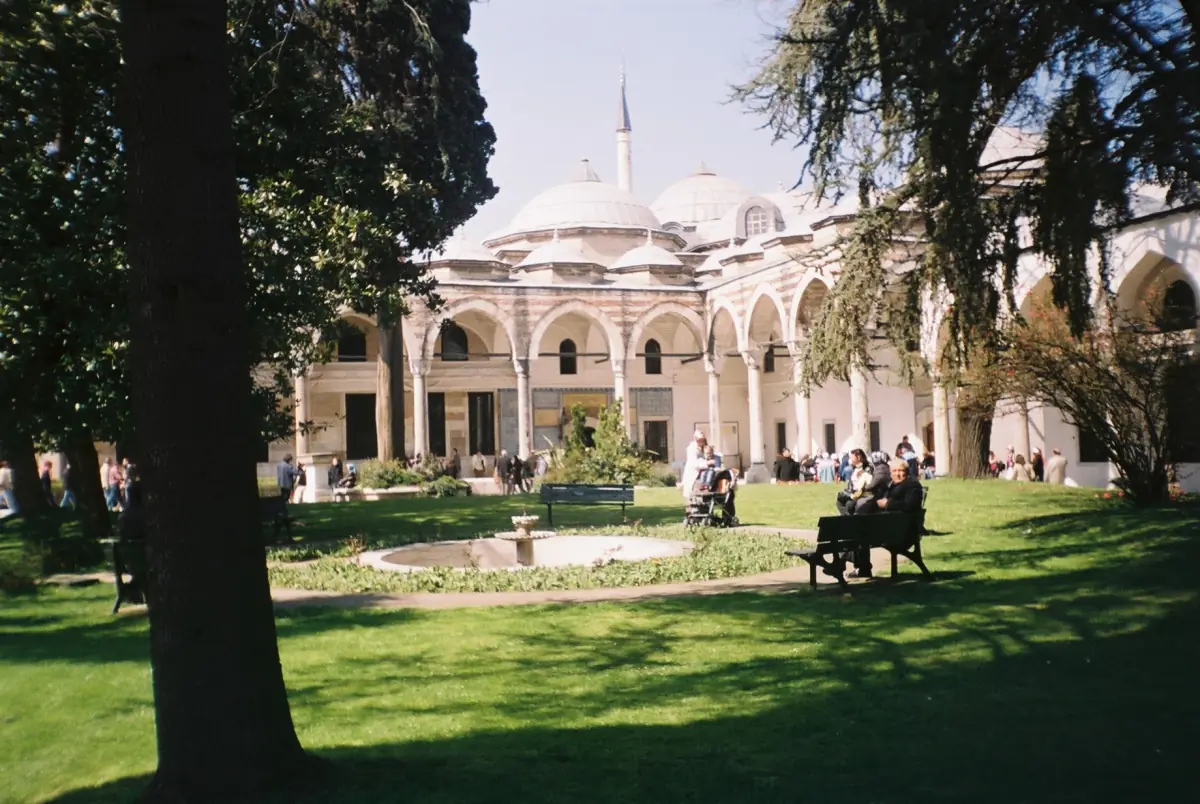
Finding your way inside Topkapi Palace
Inside Topkapi Palace, the courtyards provide a more useful starting point than a list of individual rooms. Think of the complex as a sequence from Bâb-ı Hümâyun through the first courtyard, Bâbüsselâm and the second courtyard, then Bâbüssaâde and the third courtyard before the fourth court. These names help you place the buildings around you. They describe the layout, while the visitor route on the day determines how you move through it.
Give your visit a focus before adding every collection and neighbouring museum. The government spaces, residential rooms and garden pavilions reward different kinds of attention. This page helps you organise the walk; the architecture guide explains how those buildings work together, and the tickets guide separates the admission arrangements.

The second courtyard: council spaces and kitchens
Beyond Bâbüsselâm, use the second courtyard to orient yourself around the Divan or Kubbealtı, the outer treasury and the palace kitchens. These places bring government and household work into the same field of view. Start by identifying the buildings around the court, then decide which interiors or collections to concentrate on. A courtyard is a reference point for your visit rather than a promise that each surrounding room will be part of your route.
The shift towards the inner palace becomes easier to follow when you keep the next gate, Bâbüssaâde, in mind. Avoid trying to match each doorway to an imagined fixed circuit. Instead, use the court names to regain your bearings between stops. For the historical meaning of government and residential spaces, the palace history page adds context without turning this walk into a detailed chronology.
Our take
This guided visit includes tickets for the palace, Harem and Hagia Irene.
Hand-picked tours, booked through GetYourGuide. Prices are indicative starting prices in euros (as of October 2026). Tap a tour for live availability and the current price in your currency.

Our take: a guided introduction to three palace areas
The palace, Harem and Hagia Irene visit includes all three admissions and a guide in the language of the chosen option, useful for linking the courtyard layout with its interiors.
Enderun, the library and the fourth courtyard
The Enderun area brings together the Audience Chamber, Ahmed III's library, the Fatih Pavilion with the Enderun treasury, and the relic rooms. Rather than treating these as interchangeable palace interiors, choose what you want to understand: reception, learning, collections or religious heritage. The collections guide introduces the treasury and sacred relics alongside porcelain, arms and royal clothing.
Further into the complex, the fourth courtyard includes the Revan, Baghdad, Sofa and Mecidiye pavilions and the Circumcision Room. Keep them as a group of landmarks when reading the site plan. The Harem forms another substantial residential and service complex, so give it a deliberate place in your itinerary. Its apartments, baths and restored working spaces are explained on the Harem page.
Hagia Irene: a Byzantine building in the first courtyard
Hagia Irene is a former Byzantine church that was used as an arsenal under the Ottomans. It also belongs to Istanbul's museum history: it housed collections of the Müze-i Hümayun established in 1869, a predecessor of the Archaeological Museums. This makes it a different historical stop from the Ottoman residential and government buildings deeper within the palace grounds.
Its position in the first courtyard does not make the church interior a free part of the grounds. The palace combination covers the palace, Harem and Hagia Irene, and separate Hagia Irene admission is also listed. Use the tickets page to choose the relevant arrangement. The guided option on this page includes all three areas, with English, German or Spanish guidance depending on the option selected.
Gülhane Park: the former outer garden
Gülhane was formerly the palace's outer garden and has been public since 1912. Its park entrance is free. The green spaces and paths offer a separate outdoor part of your day, rather than another museum room included in a palace circuit. Keep the distinction between public park access and admission to museum interiors clear when planning what your ticket covers.
If you want to include the park, place it alongside the palace visit as its own stop. This helps avoid using the word “grounds” too broadly: the public green space, palace courts and neighbouring museum complexes have different roles. The getting there page covers the approach through Sultanahmet and the transport connections.
The Archaeological Museums and Darphâne
The Archaeological Museums are a separate complex comprising the Archaeological Museum, Museum of the Ancient Orient and Çinili Köşk, at Osman Hamdi Bey Yokuşu in the Gülhane area. Darphâne-i Âmire is another museum complex, whose opening was announced on 26 October 2026. Treat either as a separate planning decision and check its own admission arrangements rather than extending your palace ticket to neighbouring museums.
Finish planning with the visitor rules. Interior photography and filming are prohibited, large bags must be handed in and pushchairs are not allowed indoors. These practical details matter across a visit that alternates between open courts and interiors. Keep the length of any guided product separate from the overall time you choose to spend at the museum.
Questions about the palace interior
Is Topkapi one large building?
It is a complex of courtyards, gardens, government buildings, residential spaces and pavilions.
Is Hagia Irene free?
Its interior requires admission. It is covered by the palace, Harem and Hagia Irene combination, with separate admission also listed.
Is Gülhane Park part of the museum ticket?
The public park has free entry and should be planned separately from paid museum interiors.
Does this route guarantee every room?
Use the courtyard sequence for orientation and follow the current route and access instructions at the palace.