Topkapi Palace history beyond the royal rooms
Topkapi Palace history begins with the residence commissioned by Mehmed II, but the complex is more than the story of one ruler. Over centuries, buildings, gardens and courtyards were added to an institution combining residence, government and education. That mixture explains why kitchens, council spaces and a library belong in the same visit as royal apartments and treasury collections. It also gives you a useful alternative to following a sequence of famous personalities alone.
Read the palace through the tasks it supported. Government needed meeting spaces, the household needed service rooms, and royal life occupied a complex of apartments and courts. The architecture guide explains how those functions relate spatially. Here the focus is what they reveal about the palace's changing use, including its later life as a museum.

Our take
Choose a guided palace walk with tickets, or the television-themed small-group visit for stories alongside history. Check admission costs on the themed option before booking.
Hand-picked tours, booked through GetYourGuide and Viator. Prices are indicative starting prices in euros (as of October 2026). Tap a tour for live availability and the current price in your currency.

Palace history and television stories
- English-speaking tour guide
- Small-group themed experience
- Palace and Harem visits
The guide combines history with stories from a television series. Only assistance with tickets is specified; check admission costs before booking.
Check availability →
Palace and Harem small-group walk
- Palace tickets
- Harem tickets
- Headsets
A guide leads the small-group walk. The Galataport start is available only with the relevant option.
Check availability →
Palace history walk with ticket option
- Licensed tour guide
- Headsets
- Tickets if option selected
Palace and Harem tickets are included only with the ticket option; without admission the visit stays outside up to the main gate.
Check availability →Our take: history with a guide
Choose a palace and Harem walk with tickets and headsets, a historian-led option with admission selected separately, or an English themed visit connecting television stories with historical commentary.
Residence, government and education
The palace developed over centuries rather than remaining a fixed residence. Courtyards and gardens linked government and residential buildings, and education was part of its purpose. Keeping these functions together helps explain the range of places named on the plan. A council building and a library are historical evidence of institutional life, just as apartments and baths are evidence of a household.
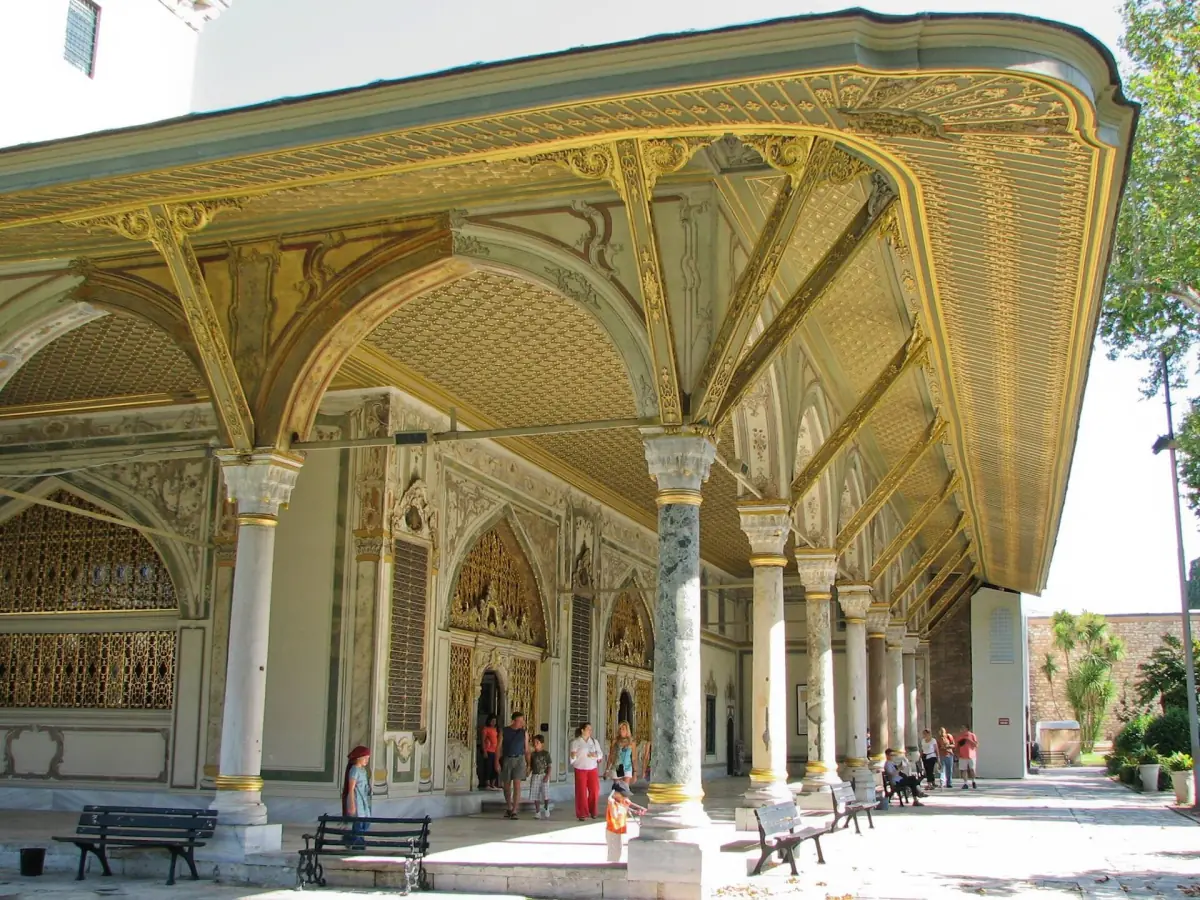
The second courtyard contains the Divan or Kubbealtı, the outer treasury and kitchens. In the Enderun, the Audience Chamber and Ahmed III's library sit within a different group of buildings that also includes the Fatih Pavilion and relic rooms. Use these landmarks to ask practical historical questions: which activity belongs here, and how does it relate to the rest of the institution? The inside route puts the court names in order for a visit.
Household history in the Harem
The Harem's Valide Sultan apartments, ruler's rooms, baths and courtyards explain only part of residential life. Service spaces add the work that sustained it. The restored Cariyeler Taşlığı presentation includes apartments, a dormitory, laundry, kitchen, storeroom, bath and coffee hearth. Looking at these alongside the grand interiors gives the household a fuller historical shape.
Restoration and presentation also belong to the modern history of the site. Karaağalar Koğuşu reopened after restoration in August 2025, and the Cariyeler Taşlığı opening followed in May 2026. These are milestones in how the palace is presented to visitors, distinct from the Ottoman uses of the rooms. Read the Harem guide for the exact dates and the scope of those additions.
Sacred relics and religious tradition
The relic rooms belong to the Enderun area. Religious tradition connects the transfer of relics with Selim's Egyptian campaign of 1517. The collection includes objects venerated as the Prophet's mantle, together with letters, swords and keys associated with the Kaaba. Describe those associations as religious tradition and collection history, while approaching the objects respectfully as part of a living heritage.
This distinction matters when interpreting the collections: an object's sacred attribution and its place in palace life are different questions from a modern visitor's route. The treasury and collections guide brings the relics together with arms, porcelain, royal clothing and celebrated treasury objects. Appropriate covering is required in the relic area, and interior photography and filming are prohibited.
From palace to museum
The palace became a museum on 3 April 1924 and has been administered by Millî Saraylar since 2019. These dates frame a different chapter from the court's residential and governmental history. Today, the buildings and collections can be read together, but an exhibition is also a modern arrangement of historical material. Give the rooms attention as architecture while considering the objects as part of a museum presentation.
Recent exhibition openings continue that museum chapter. The tile gallery opening was announced in December 2025, and the Şerbethane presentation opened in July 2026. The latter concerns sherbet, sweets, essences and serving culture as an exhibition. It provides another route into palace life through material culture, alongside the more familiar government and residential themes.
History on a walk: television stories and evidence
A television-themed English small-group visit connects stories of Suleiman, Hürrem Sultan and Ibrahim Pasha with palace and Harem commentary. Use the dramatic narrative as a point of interest while keeping fictional scenes separate from historical events. Its inclusions provide assistance with the entrance ticket, so budget admission separately from the guided experience.
The historian-led palace and Harem option includes a licensed guide and headsets; entrance tickets belong to the option that includes them. Its base price should therefore be read as a guided-service price rather than a palace admission price. Another small-group walk includes palace and Harem tickets, a local history guide and headsets, with a Galataport start only in the selected option. Compare the guided visit formats and admission arrangements before choosing. Product length describes the guided experience, rather than fixing your total museum visit.
Palace history questions
Who commissioned Topkapi Palace?
Mehmed II commissioned the palace, which was expanded over subsequent centuries.
When did it become a museum?
The palace became a museum on 3 April 1924.
Was it only a royal residence?
Residence, government and education were all among its historical functions.
Does a television-themed tour replace historical interpretation?
It combines series stories with historical commentary. Keep dramatic scenes distinct from documented palace history.